

The Blantyre to Johannesburg bus is one of the longest and most logistically interesting overland routes in southern Africa. It connects Malawi’s commercial capital — a city of markets, traders, and the country’s busiest bus terminal at Wenela — to Johannesburg, the economic engine of the continent, across roughly 1,700 kilometres of road that passes through not two but three countries. To get from Blantyre to Johannesburg by road, you go through Mozambique and Zimbabwe before crossing into South Africa at Beit Bridge. Four countries, three border crossings, one very long bus ride.
People who make this journey do so for serious reasons. Malawian traders moving goods to and from the South African wholesale markets. Workers heading to Johannesburg. Families visiting relatives. Travellers doing the overland route through southern Africa. This is not a casual day trip — it is a genuine long-haul bus journey that takes the better part of two days, and it requires the right operator, the right documents, and realistic expectations about what lies ahead.
This guide covers everything you need: the operators running the route, 2026 fares, the full schedule, the three border crossings, the documents you must carry, how to book, and the practical tips that experienced travellers on this corridor have learned from doing it.
How Far is Blantyre from Johannesburg by Road?
The road distance from Blantyre to Johannesburg is approximately 1,700 kilometres. The most common route goes west from Blantyre through Mwanza to the Malawi–Mozambique border at Zobue, then southwest through Tete and across Mozambique on the Tete Corridor, crossing into Zimbabwe at Nyamapanda, continuing through Zimbabwe to Harare and south to Beit Bridge, and finally crossing into South Africa at Musina for the drive down to Johannesburg.
The journey takes approximately 24 hours on a direct bus. That is a full day and night on the road — something to plan around, not something to underestimate.
The Road Route: Blantyre to Johannesburg in Full
Understanding the route before you travel makes the journey significantly less disorienting. Here is what you pass through:
Blantyre to Mwanza (Malawi): The bus heads west from Wenela Bus Station in Blantyre through the Shire Highlands. Mwanza is approximately 95 kilometres from Blantyre and is the last Malawian town before the border with Mozambique. Most buses fuel up here.
Mwanza–Zobue border (Malawi–Mozambique): This is the first crossing — the Mwanza border on the Malawian side connecting to Zobue in Mozambique’s Tete Province. This is a busy commercial border, heavily used by freight trucks on the Tete Corridor. The landscape here is hilly and rural. Truck congestion can build, particularly during the day. The border runs 24 hours but processing after dark is slower.
Tete Corridor (Mozambique): After crossing into Mozambique at Zobue, the bus heads southwest toward Tete city — about 118 kilometres from the border. Tete is famous for its massive suspension bridge over the Zambezi River. Crossing that bridge in the early morning or at night, with the Zambezi below and the orange lights of the refinery in the distance, is one of those moments that makes you remember why you travel by bus and not by plane. From Tete, the road continues through Moatize and southwest toward the Zimbabwe border at Nyamapanda.
Nyamapanda border (Mozambique–Zimbabwe): The second crossing takes you from Mozambique’s Tete Province into Zimbabwe’s Mashonaland East Province at Nyamapanda. This is a smaller, quieter crossing than Beit Bridge or the Mwanza–Zobue border, primarily serving passenger traffic and light vehicles. Processing is generally faster here.
Harare (Zimbabwe): From Nyamapanda, the bus heads southwest to Harare — Zimbabwe’s capital and the major city on this transit route. Some buses make a stop in Harare. Then it is south through Masvingo toward Beit Bridge.
Beit Bridge border (Zimbabwe–South Africa): The third and final crossing — Beit Bridge over the Limpopo River — is the main gateway between Zimbabwe and South Africa. It is one of the busiest land borders in Africa and wait times here are the most unpredictable of the three crossings. From a few hours to most of a day on a very bad day. Once through, the bus continues south on the N1 through Limpopo Province toward Johannesburg.
Johannesburg: The final destination, arriving at the operator’s terminal in the city.
The Operators: Who Runs the Blantyre to Johannesburg Bus
1. Ulemu Bus Services — The Primary Operator
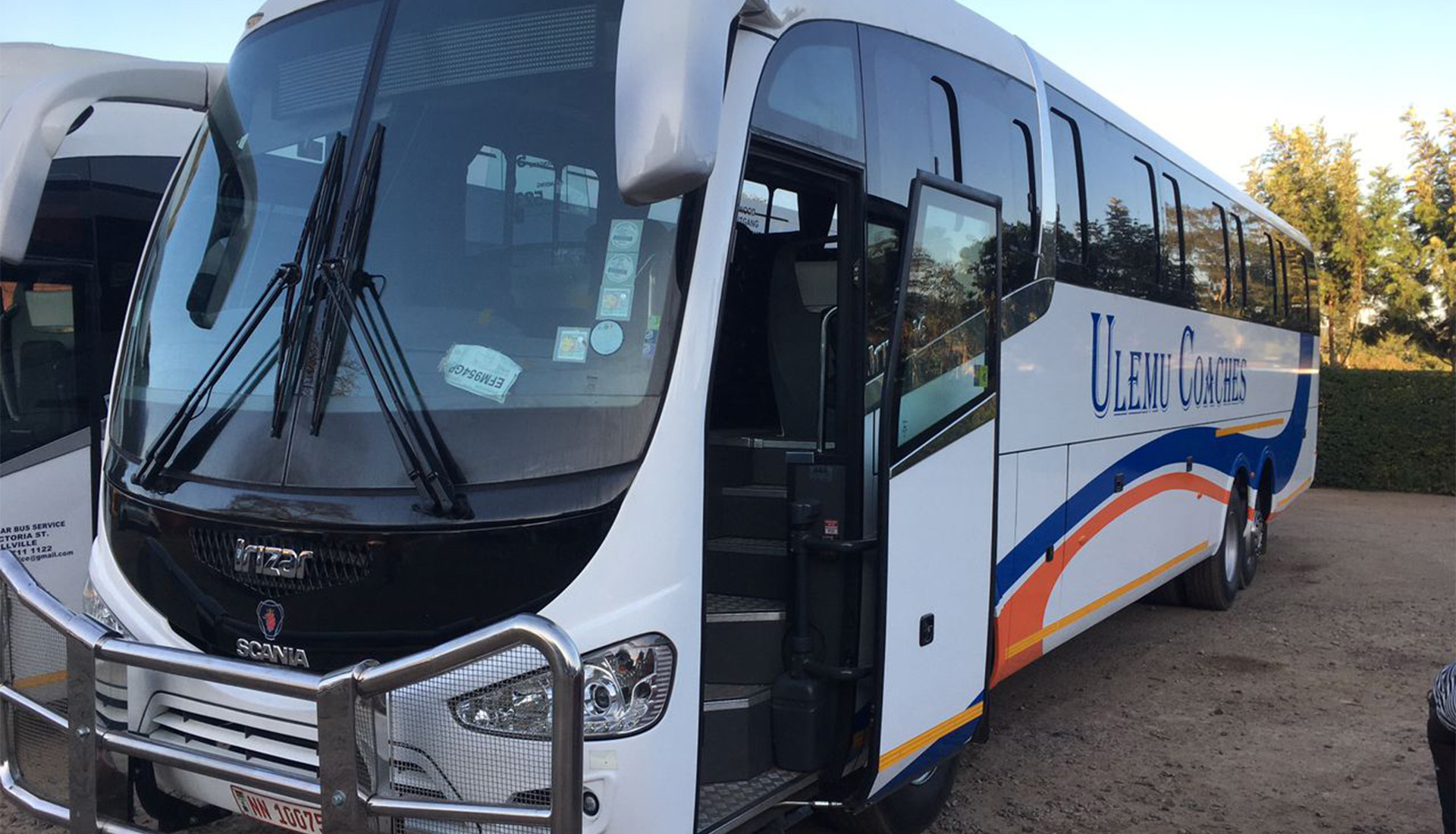
Ulemu Bus Services has established a well-scheduled travel route between Malawi and South Africa (Johannesburg) and is the most established and most recognised operator on the Blantyre to Johannesburg bus route. The company is based in Blantyre with their head office at Wenela — the same location as Blantyre’s main bus terminal — which makes them extremely convenient to find and book with.
Ulemu has built a robust transport business of over 20 buses and trucks operating within Malawi and cross-border to South Africa, Zimbabwe, Zambia, and Mozambique. Their fleet features Scania with Irizar bodies and newer Zhongtong buses recently imported from China, and they maintain their own workshop for regular vehicle maintenance.
Aboard Ulemu buses you will find reclining seats, air conditioning, and sockets to charge electronic devices. For a 24-hour journey, functioning power sockets are not a luxury — they matter. Confirm availability when booking as not all vehicles have working sockets on every trip.
Based on Busbud traveller reviews, Ulemu Bus Service has an overall rating of 1.5/5. In key areas, travellers rate them 2.1/5 for punctuality and timeliness, 1.0/5 for cleanliness, and 1.0/5 for Wi-Fi connectivity. These are low scores and worth being honest about. Ulemu is not a luxury coach experience. It is a budget operator running a difficult long-haul cross-border route, and the reviews reflect that reality. Most travellers on this corridor report the bus gets the job done — you arrive in Johannesburg — but the comfort and punctuality fall well short of what you would expect from a premium operator.
Ulemu departure schedule from Blantyre:
Wednesday: 5:00 AM — Blantyre to Johannesburg Saturday: 5:00 AM — Blantyre to Johannesburg
That is two departures per week from Blantyre. Wednesday and Saturday at 5:00 AM from Wenela Bus Station.
Return schedule (Johannesburg to Blantyre):
Wednesday: 7:30 AM — Johannesburg to Blantyre Friday: 7:30 AM — Johannesburg to Blantyre Sunday: 7:30 AM — Johannesburg to Blantyre
Three return departures per week from Johannesburg — Wednesday, Friday, and Sunday mornings.
Ulemu Blantyre head office: Wenela, Blantyre Lodge, P.O. Box 1154, Blantyre, Malawi. Tel: +265 982 848 428. Email: blantyre@ulemubuses.com
Ulemu Johannesburg office: 73 Kerk Street / Nurkerk Building, Hillbrow, Johannesburg, 2000. Tel: +27 73 145 1003. Email: johannesburg@ulemubuses.com
Ulemu Lilongwe office: Kalikuti Hotel, Behind Biwi Triangle. Tel: +265 982 848 429. Email: lilongwe@ulemubuses.com
Book directly at ulemubuses.com or through third-party platforms (see below).
2. Transi-Africa Tours
Transi-Africa Tours offers one daily bus from Blantyre to Johannesburg at an average price of $113, with tickets starting from $113. This is an alternative to Ulemu and offers more frequent departures — daily rather than twice weekly.
Transi-Africa Tours is bookable through Busbud and other aggregator platforms. For travellers who need more schedule flexibility than Ulemu’s Wednesday and Saturday departures offer, Transi-Africa is worth checking.
3. Other Operators
ENKOSI also operates on the Blantyre to Johannesburg corridor. Several smaller operators also run services on this route, often bookable through Busbud or via direct contact in Blantyre. Check availability if Ulemu and Transi-Africa do not have seats on your preferred date.
Blantyre to Johannesburg Bus Fares 2026
| Operator | Fare (USD approx.) | Fare (ZAR approx.) | Frequency | Journey Time |
|---|---|---|---|---|
| Ulemu Bus Services | $90 – $120 | R1,400 – R2,200 | Wed & Sat | ~24 hours |
| Transi-Africa Tours | $113 – $122 | R2,000 – R2,200 | Daily | ~24 – 35 hours |
| ENKOSI | Confirm at booking | Confirm at booking | Confirm | ~24 hours |
The cheapest bus tickets from Blantyre to Johannesburg start from $94. The average price for this route is around $122.
Before Covid, the bus ticket from Johannesburg to Blantyre was R1,400 — and total costs including incidentals came to below R2,000.Fares have risen since then — expect to pay R1,600 to R2,200 in 2026 depending on operator and booking timing.
Note: Fares on this route are sometimes quoted in USD and sometimes in ZAR or Malawian Kwacha depending on the operator and which end you are booking from. Always confirm the currency and current fare directly with the operator or booking platform before purchasing.
How to Book the Blantyre to Johannesburg Bus
Method 1: Book at the Ulemu Office in Blantyre
The most straightforward option for travellers in Blantyre. Head to the Ulemu head office at Wenela Bus Station — the same location as Blantyre’s main bus terminal. Buy your ticket in person with cash (MWK or USD accepted) and confirm your departure day (Wednesday or Saturday).
Ulemu accepts cash payments at their office depots or at boarding time for both local and international travel. For international travel, if you pay cash, keep the receipt safe and take it with you during travel.
Method 2: Book via the Ulemu Website
Go to ulemubuses.com to check schedules and book online. The website accepts online payment for both domestic and international routes.
Method 3: Book via Busbud
busbud.com lists Ulemu Bus Services, Transi-Africa Tours, and ENKOSI on the Blantyre to Johannesburg route with real-time availability. International credit and debit cards are accepted. On selected Ulemu routes, Busbud offers a Refund for Any Reason add-on at checkout, allowing refunds up to 30 minutes before departure. This is worth adding if your plans are uncertain — Ulemu’s own cancellation terms are less flexible.
Method 4: Book via Tiketi
tiketi.com lists Ulemu Bus Services for this route and allows online booking with mobile money payment — useful for travellers in Malawi who prefer this payment method.
General booking tips:
- Book at least 3–5 days in advance for regular travel
- Book 1–2 weeks ahead around Malawian and South African public holidays, Christmas, Easter, and school holiday periods
- Confirm your departure day carefully — Ulemu runs Wednesday and Saturday from Blantyre, not daily
- If you book online with Ulemu directly and pay cash at the office later, get a written reservation confirmation
- Keep your ticket and cash receipt with you throughout the journey — you may be asked to show proof of payment at boarding
Documents You Must Carry: Four Countries, Three Crossings
This is the most important section of this guide. The Blantyre to Johannesburg bus passes through Malawi, Mozambique, Zimbabwe, and South Africa. You need valid documentation for every single country.
1. Valid International Passport
A national ID is not sufficient for any of the three border crossings on this route. You need a valid international passport with at least 6 months of validity beyond your travel date and blank pages for entry and exit stamps. You will collect stamps at Mwanza/Zobue, Nyamapanda, and Beit Bridge — that is at minimum six stamp entries across the trip.
2. Mozambique Visa or Transit Permit
Most nationalities require either a Mozambique tourist visa or a transit visa to pass through the Tete Corridor. A full tourist visa costs $50–$80 USD depending on nationality. Many nationalities can obtain a visa on arrival at the Zobue border, but check current requirements for your specific passport at the Mozambique embassy or consulate before travel. SADC nationals (South Africans, Zimbabweans, Zambians, Malawians, and others) enter Mozambique visa-free for short stays — confirm current visa-free eligibility at the nearest Mozambique embassy if you are unsure.
3. Zimbabwe Visa
Most nationalities can enter Zimbabwe on a visa on arrival at Nyamapanda or via the KAZA UniVisa (which covers both Zimbabwe and Zambia). The standard tourist visa costs $50 USD (single entry) or $30 for transit. SADC nationals enter Zimbabwe visa-free. Check current requirements at evisa.gov.zw before travel.
4. South African Visa (if required)
South Africa has a visa requirement for some nationalities. Most African passport holders, including Malawian citizens, can enter South Africa visa-free for short stays. Non-African nationalities should check current South African visa requirements at the nearest South African High Commission before travelling.
5. Yellow Fever Card
South Africans do not need a visa to travel to Mozambique or Zimbabwe, and the borders are hassle-free as long as your documents are up to date. However, a yellow fever vaccination card is required if you are arriving in any of these countries from a yellow fever endemic zone. Carry your original WHO Yellow Card as a precaution regardless.
6. Currency
You will need to be financially prepared for four currencies across the journey:
- MWK (Malawian Kwacha) — for Blantyre and the first stretch to the border
- USD — the most universally useful currency across all four countries, especially for visa fees and border expenses
- ZAR (South African Rand) — for the South African section and arrival in Johannesburg
- Mozambican Metical (MZN) — useful for roadside stops in Mozambique, though USD is often accepted
Carry enough USD in clean, post-2013 notes for all visa fees and border expenses. Do not rely on finding ATMs at border crossings.
Documents Checklist
| Document | Required? | Notes |
|---|---|---|
| Valid international passport | Yes — mandatory | 6+ months validity, blank pages for 6+ stamps |
| Mozambique visa or transit permit | Depends on nationality | Visa on arrival available at Zobue |
| Zimbabwe visa | Depends on nationality | Visa on arrival at Nyamapanda, $50 single entry |
| South Africa visa | Depends on nationality | Most African nationals visa-free |
| Yellow fever card (original WHO) | Recommended | Required if arriving from endemic zone |
| USD cash (clean, post-2013) | Yes — essential | For all visa fees and border expenses |
| ZAR cash | Useful | For arrival expenses in Johannesburg |
The Three Border Crossings: What to Expect
Crossing 1: Mwanza–Zobue (Malawi → Mozambique)
The Mwanza–Zobue crossing is the most important and busiest land gateway between Malawi and Mozambique — the main border on the Tete Corridor, the vital transport artery linking landlocked Malawi with the Mozambican port of Beira. This is not a major tourist crossing, but it is a critical commercial lifeline — a constant, slow-moving river of freight trucks carrying fuel, food, and other essential goods into Malawi.
All passengers disembark, clear Malawian exit immigration, then cross to Mozambique immigration. “Fixers” (touts) will offer their help for a fee — it is generally best to politely decline and handle the process yourself, but it requires patience. Truck congestion can delay processing at this crossing significantly.
Expect 1–3 hours here depending on traffic volume.
Crossing 2: Nyamapanda (Mozambique → Zimbabwe)
This is the quieter of the three crossings. The bus exits Mozambique’s Tete Province and enters Zimbabwe’s Mashonaland East. Processing is generally faster here than at the other two crossings. Visa on arrival is available for most nationalities.
Expect 30–90 minutes here on a normal day.
Crossing 3: Beit Bridge (Zimbabwe → South Africa)
For travellers entering South Africa from Zimbabwe, Beit Bridge is the primary land crossing, though it is often congested. Expect significant traffic, especially during peak travel times and holidays. Be prepared for potential delays and ensure you have all necessary travel documents.
If your bus leaves Johannesburg on time, you will reach Beit Bridge just after sunset. Depending on the time of year, you might find long queues, but once you reach the immigration officers things generally move quickly. Just remember to always stay with the passengers from your coach and make sure you can locate your bus at any given moment. At Beit Bridge, losing track of your bus amid the crowds and trucks is more realistic than it sounds.
Expect 1–5 hours at Beit Bridge. On a bad day — Friday afternoon, public holidays, Christmas period — this can stretch significantly longer. It is unpredictable. Budget time for it.
Blantyre to Johannesburg Bus vs. Flying
Direct flights between Blantyre’s Chileka International Airport (BLZ) and Johannesburg’s OR Tambo International Airport operate via Ethiopian Airlines and Airlink.
| Factor | Bus | Flight |
|---|---|---|
| Journey time | ~24 hours | 2 hours (air time) / ~4–5 hrs with airport time |
| Fare | $90 – $122 | $180 – $400+ |
| Luggage | Generous — no airline limit | 15–23 kg, excess charged |
| Borders | Three crossings (Mozambique, Zimbabwe, SA) | Single passport check at airport |
| Convenience | Departs from city centre Wenela terminal | Chileka Airport, outside Blantyre |
| Best for | Budget travellers, traders, heavy luggage | Time-sensitive travel |
The price difference is significant — you save $90 to $280 per person on the bus compared to flying. For traders moving goods, the bus is the only realistic option. For most budget travellers and anyone not in a hurry, the bus is the right financial decision. For business travellers or anyone who values their time above cost, the 2-hour flight removes an enormous amount of logistical complexity.
Return Journey: Johannesburg to Blantyre Bus
The Ulemu return service from Johannesburg to Blantyre departs Wednesday, Friday, and Sunday at 7:30 AM from their Johannesburg office at 73 Kerk Street, Hillbrow.
Buy your return ticket from the Johannesburg office before you depart Blantyre if your return dates are fixed. The Hillbrow area of Johannesburg, where the Ulemu office is located, is a busy inner-city neighbourhood — go directly to the office, buy your ticket, and do not linger.
Tips for a Smooth Blantyre to Johannesburg Bus Journey
- Book your ticket well in advance — Ulemu runs only on Wednesdays and Saturdays from Blantyre. Missing your departure day means waiting 3–4 days for the next one
- Be at Wenela by 4:30 AM — the bus departs at 5:00 AM and good seats go early. There is no assigned seating on most departures
- Sort all your visas before you travel — Mozambique visa, Zimbabwe visa, and South African visa if required. Do not assume you can sort everything at the border
- Carry USD in clean, post-2013 notes — this is the most universally useful currency across all four countries. Carry enough for all three visa fees plus buffer for expenses
- Pack food and water for 24+ hours — roadside stops exist but are unpredictable in timing and quality. Carry enough to be comfortable for a full day without relying on any stop
- Bring a power bank — 24 hours is a long time. Even if the bus has sockets, carry a fully charged power bank as backup
- Keep your documents in one accessible place — you pull them out at three border crossings. A neck wallet or travel pouch inside your clothing is the most secure option
- Stay with your bus at Beit Bridge — the crossing is chaotic and it is genuinely easy to lose track of which coach is yours among the dozens of vehicles. Identify a landmark near your bus before you disembark
- Do not change money at the borders — rates are consistently poor. Change only what you need for immediate expenses and use banks or ATMs in Johannesburg
- Book a window seat if you can — the journey through southern Africa’s landscapes is genuinely beautiful, particularly through Zimbabwe during the green season. A window seat makes the hours pass differently.
- Take a travel pillow and a light blanket — nights on the bus get cold, particularly at altitude through Zimbabwe
Where to Board in Blantyre and Where to Arrive in Johannesburg
Blantyre departure: Ulemu Bus Services head office and departure point is at Wenela, Blantyre Lodge — the same location as Wenela Bus Station, Blantyre’s main long-distance terminal. Most transport in Blantyre knows Wenela and any taxi or minibus can take you there.
Johannesburg arrival: The Ulemu Johannesburg office is at 73 Kerk Street / Nurkerk Building, Hillbrow, Johannesburg, 2000. Hillbrow is a dense inner-city neighbourhood. From the Ulemu office, take a metered taxi, Uber, or Bolt to your accommodation rather than walking with luggage.
Frequently Asked Questions (FAQ)
How long does the Blantyre to Johannesburg bus take? Approximately 24 hours for the direct bus. This includes three border crossings — Mwanza–Zobue (Malawi–Mozambique), Nyamapanda (Mozambique–Zimbabwe), and Beit Bridge (Zimbabwe–South Africa). Border wait times are the biggest variable — a slow Beit Bridge crossing can add several hours to the total journey.
How much is the Blantyre to Johannesburg bus fare in 2026? Tickets start from approximately $94 with the cheapest operators, with an average fare of around $122. Ulemu Bus Services fares range from approximately $90 to $120 USD. In ZAR, expect to pay R1,600 to R2,200.
Which bus companies go from Blantyre to Johannesburg? Ulemu Bus Services, Transi-Africa Tours, and ENKOSI are the main operators on this route. Ulemu is the most established with offices in both Blantyre and Johannesburg.
How many days a week does the Blantyre to Johannesburg bus run? Ulemu departs Blantyre on Wednesdays and Saturdays at 5:00 AM. Transi-Africa Tours offers daily departures. Check availability on both platforms before finalising your travel date.
What border crossings does the bus go through? Three crossings: Mwanza–Zobue (Malawi into Mozambique), Nyamapanda (Mozambique into Zimbabwe), and Beit Bridge (Zimbabwe into South Africa). You need valid visas or visa exemptions for each country.
Do I need a visa for Mozambique and Zimbabwe? It depends on your nationality. Many SADC nationals enter both countries visa-free. Most other nationalities pay for a visa on arrival at each crossing. Check current requirements for your specific passport before travel — at the Mozambique and Zimbabwe embassies or at evisa.gov.zw.
Where do I buy the Ulemu bus ticket in Blantyre? At the Ulemu head office at Wenela Bus Station in Blantyre. You can also book online at ulemubuses.com, through Busbud, or via Tiketi.
Where does the bus arrive in Johannesburg? At the Ulemu office at 73 Kerk Street, Hillbrow, Johannesburg. Take an Uber, Bolt, or metered taxi from here to your accommodation.
Is the Blantyre to Johannesburg bus safe? The route is well-travelled and thousands of Malawians use it regularly. The main safety considerations are keeping your documents secure, staying with your bus at border crossings, and using established operators. Exercise standard big-city awareness on arrival in Johannesburg, particularly in the Hillbrow area.
Can I send a parcel on the Ulemu bus? Ulemu offers parcel and courier services across Malawi and to and from South Africa. Contact their offices for rates and restrictions.
Final Word
The Blantyre to Johannesburg bus is a genuine overland adventure — four countries, three borders, 24 hours, and more landscapes than most people see in a year of shorter trips. It is not a comfortable or luxurious journey. The buses are functional rather than premium, the border crossings require patience, and Beit Bridge on a bad day can test anyone’s resolve. But people do this route every week, the operators know what they are doing, and you arrive in Johannesburg having seen a cross-section of southern Africa that a two-hour flight would never give you.
Sort your visas before you leave Blantyre, carry enough USD for all border fees, pack food and water for the full day, keep your documents accessible, and stay with your bus at Beit Bridge.
Ready to book? Visit ulemubuses.com to check the Wednesday and Saturday departure schedule, or use busbud.com to compare Ulemu, Transi-Africa Tours, and ENKOSI on this route. For more southern Africa bus guides, visit the ShopInKenya bus bookings section.


